Battletoads / GAME HISTORY
Why Does Player 2 Stop Moving in Battletoads' Clinger Winger?
Clinger Winger can strand the second player in the original North American NES game. That does not mean every two-player run has to end there.
Short answer
The original North American NES release has a two-player fault in Clinger Winger: the second player cannot ride through the stage normally. But a reported workaround lets that player sit the stage out and return afterward. A broken co-op stage and an impossible co-op completion are different claims. [1]
Scope: Original North American NES Battletoads and historical player reports. This is not a compatibility guide for every regional release or collection.
The problem isn't another missed corner
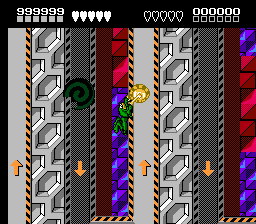
Clinger Winger puts a toad on a small wheeled vehicle and sends it around a track. In the affected two-player game, the second rider cannot complete that journey normally. Practising the corners won't make that player behave like the first. The level's reputation for difficulty can hide a simpler problem: one participant is stuck. [1]
How can people still finish a two-player run?
In a July 2024 account, marmaxgaming1 described finishing the original NES game with a friend. Their solution was to leave player two out during Clinger Winger rather than immediately continuing. Player two could then return for the final stage, The Deadly Tower. Another participant in the discussion explained that rejoining happens at the between-level screen and requires a run that began in two-player mode. Those are player reports, not a Patchlo hardware test. [1]
That distinction matters when watching a full run. Two people appearing at the ending doesn't show that both rode through Clinger Winger. Check what happens at the transition into and out of stage 11.
The remake of the story can be wrong, too
It's tempting to shorten this to “Battletoads cannot be beaten with two players.” That leaves out the most interesting part: players found a way to carry a co-op run past a stage that wouldn't cooperate.
The safe description is narrower. Player two's movement is broken here in the affected release; sitting out the stage is a reported way around it. Neither statement proves the same behaviour in a Japanese cartridge, a European release or a later collection. Check the release before comparing two recordings.
Join the conversation
Have a question, correction or a different take? Share it below. Comments appear immediately after submission.
Reader comments
Loading comments…