Pac-Man / GAME HISTORY
Why Does Pac-Man’s Level 256 Split the Screen?
A routine meant to draw a few bonus icons keeps writing across the maze. The machine has not simply run out of memory.
Short answer
Pac-Man’s level 256 breaks because the bonus-icon drawing routine runs far beyond its intended limit and overwrites part of the maze’s display data. The corrupted right side also leaves too few dots for a normal clear.
Scope: Original 1980 arcade game; not the later game PAC-MAN 256.
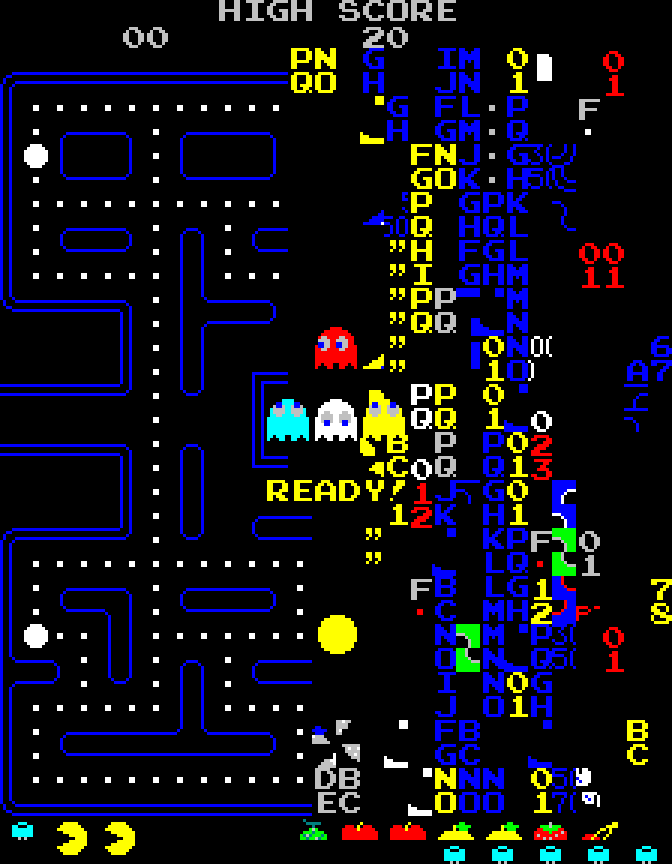
Why would the fruit icons damage the maze?
Watch the lower edge of an ordinary board: the small bonus symbols are part of the display, just like the maze tiles. Drawing those symbols means writing to the machine’s video memory.
On board 256, an eight-bit counter wraps, and that short drawing job becomes a 256-iteration job. Chris Lomont’s emulator research identifies the fruit-drawing routine as the source of the damage. The changing letters and fragments are not a deliberately designed second half of the level.
Why does only half the board look broken?
The writes spread into the display area occupied by the right-hand side. The screenshot makes the contrast easy to see: familiar corridors survive on the left, while the right contains characters that do not belong in a maze.
It is tempting to call this the machine running out of memory. That misses the useful distinction. The program writes the wrong data into memory it already has. A bigger score or another life does not repair those writes.
Why can’t eating the remaining dots finish it?
Progress depends on the game’s dot requirement, not on whether the player has explored every visible corridor. The damaged board does not supply enough dots for an ordinary clear. Knowing a route through the visible half therefore does not solve the underlying problem.
This is why a patch to the drawing routine and a good playing pattern are different things. A patch changes the faulty program; a pattern changes the player’s movement. The later PAC-MAN 256 turns the visual idea into a different game, so footage from that release is not evidence of the original arcade bug.
Join the conversation
Have a question, correction or a different take? Share it below. Comments appear immediately after submission.
Reader comments
Loading comments…