Castlevania (NES) / GAME HISTORY
Why Can NES Castlevania Crash During the Death Fight?
The early US revision can return from an interrupt with the wrong ROM bank selected. Busy scenes expose more than sprite flicker.
Short answer
NESdev documents a crash in US revision 0 of Castlevania in which the wrong ROM bank is loaded after the NMI routine runs. Busy scenes such as the Death fight can expose it. “Too many sprites” describes a condition around the failure, but misses the bank-selection error. [1]
Scope: Original NES Castlevania, US revision 0. This is separate from the Nintendo DS Portrait of Ruin dialogue softlock.
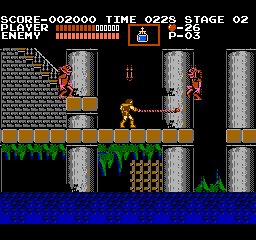

A crowded screen does not explain the whole freeze
The Death fight fills the room with threats the player must track while attacking. If the game freezes there, sprite overload is an easy diagnosis. Ordinary sprite limitations, however, are not the same failure as execution resuming with the wrong part of the game’s program available.
The NESdev bug entry identifies the latter problem in the early US revision. An NMI is an interrupt normally used for work associated with the next display frame. Bank switching selects which section of cartridge data or code is accessible. If the selection is wrong when game logic resumes, execution can fail. [1]
The revision belongs in the bug’s name
Calling this “the Castlevania crash” hides an important boundary: the technical entry singles out US revision 0. A different release failing to reproduce it is not automatically evidence that a player imagined the original fault.
It also prevents a misleading shortcut. A freeze in a later collection could have another cause; this historical explanation is not a diagnosis of every emulator, ROM modification or modern port.
The distinction from Portrait of Ruin is equally useful. There, skipping a scene and returning to a room can block progress. Here, the documented issue concerns interrupt handling and the selected ROM bank. Both stop a run, but they leave very different evidence behind.
Join the conversation
Have a question, correction or a different take? Share it below. Comments appear immediately after submission.
Reader comments
Loading comments…